Article: How Is Phycocyanin Extracted? The Science Behind the Blue
How Is Phycocyanin Extracted? The Science Behind the Blue
Discover how patented French cold-water extraction technology transforms freshwater spirulina into a carefully produced liquid phycocyanin supplement.
By Cyanora Editorial | October 28, 2026
From Green Spirulina to Brilliant Blue
How does a naturally green microorganism become a brilliant blue liquid?
The answer lies in one of the most fascinating applications of modern biotechnology: phycocyanin extraction.
Phycocyanin is a naturally occurring blue protein-pigment found in spirulina (Arthrospira platensis). Within this freshwater microorganism, it plays an essential role in photosynthesis by helping capture light energy.
But recovering phycocyanin is far more complex than simply processing spirulina.
The challenge is to release this delicate compound, separate it from other cellular components, and maintain its structural integrity throughout manufacturing.
At CYANORA, we believe the extraction process deserves as much attention as the ingredient itself.
1. It All Begins with Freshwater Spirulina
The journey begins in Brittany, France, where spirulina is cultivated under controlled conditions.
Unlike marine seaweed, spirulina is a photosynthetic cyanobacterium cultivated in freshwater-based systems.
Its growth depends on carefully managed conditions, including light, temperature, nutrients, and water quality.
Inside its cellular structures is phycocyanin, the remarkable blue protein-pigment that gives spirulina its distinctive blue-green characteristics.
Once the spirulina is harvested, specialized extraction technology is required to recover this compound.
The quality of the starting biomass, the way it is handled, and the processing conditions can all influence the resulting extract.
2. How Is Phycocyanin Extracted?
Phycocyanin is naturally water-soluble, but it is contained within spirulina's cellular structures.
To recover it, manufacturers must make the pigment accessible and separate it from other biological material.
Different producers use different methods.
Some processes involve freezing and thawing to help disrupt cellular structures. Others use mechanical techniques, filtration systems, or membrane separation technologies.
These approaches can produce extracts with different characteristics depending on their operating conditions, purification steps, and formulation choices.
The central challenge is not simply obtaining a blue liquid.
It is recovering a sensitive protein-pigment while controlling temperature, composition, microbiological quality, and stability.
3. Patented Cold-Water Extraction: French Biotechnology Expertise
CYANORA's liquid phycocyanin is produced in Brittany, France, in collaboration with a specialized French biotechnology partner with more than 30 years of expertise in microalgae.
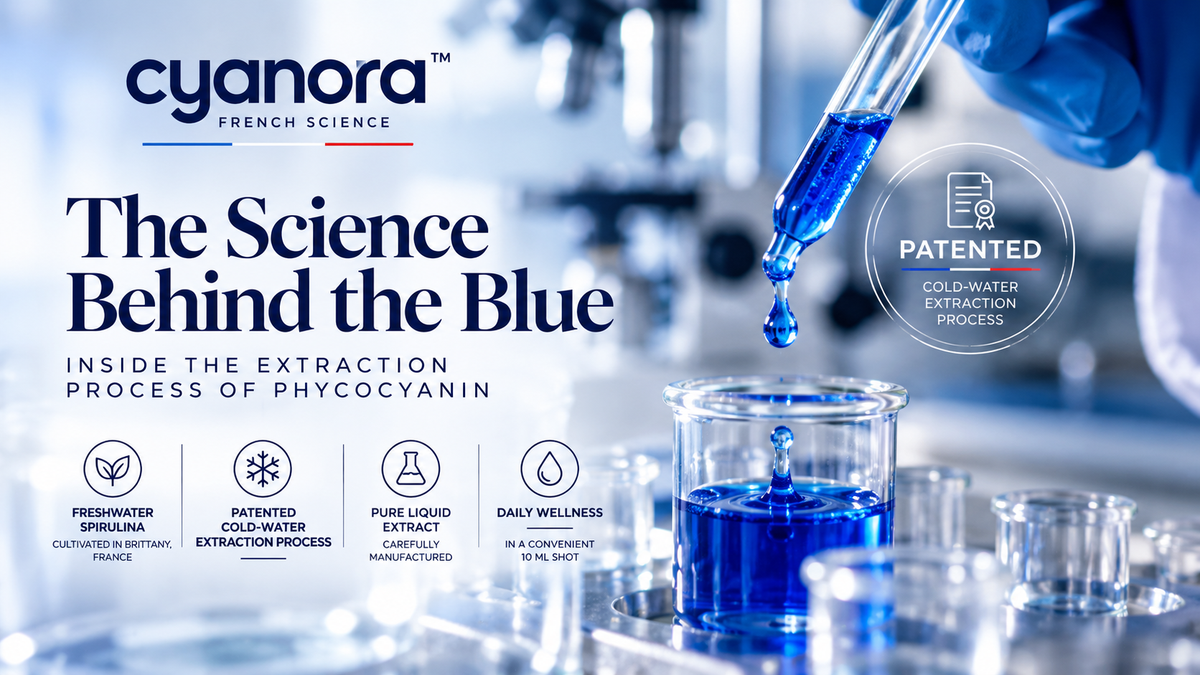
Our manufacturing partner uses a Patented Cold-Water Extraction Process developed to help preserve the original molecular structure of phycocyanin.
This proprietary technology uses water and carefully controlled low-temperature conditions to extract the blue protein-pigment.
The process is designed to limit heat-related changes during extraction while maintaining the characteristics of the liquid extract.
The patented technology was developed by our French biotechnology partner and is used in the manufacturing of CYANORA's liquid phycocyanin.
For CYANORA, this partnership connects decades of French scientific expertise with a convenient daily supplement designed for the American market.
4. Why Does Cold-Water Extraction Matter?
Phycocyanin is a sensitive protein-pigment.
Its stability can be affected by several factors, including temperature, light, pH, and processing conditions.
Excessive heat may change its molecular structure and affect its characteristic blue color.
Cold-water extraction is designed to reduce exposure to high temperatures during the recovery process.
Water is also a suitable extraction medium because phycocyanin is naturally water-soluble.
However, temperature control is only one element of quality.
The starting material, separation methods, concentration, microbiological controls, packaging, and storage conditions are all important.
The value of advanced extraction technology lies in controlling the complete process, not simply producing a blue liquid.
5. Why Extraction Methods Are Not All the Same
Across the phycocyanin industry, manufacturers use different extraction and stabilization approaches.
Some use freeze-thaw techniques, followed by filtration and ultrafiltration.
Others employ specialized separation technologies or formulate their extracts with ingredients intended to support stability.
These differences matter because two products with a similar blue appearance may have different compositions, concentrations, and manufacturing specifications.
A patented extraction method identifies a specific technological approach.
It does not automatically establish superior absorption, greater clinical effectiveness, or better health outcomes than every other formulation.
At CYANORA, our focus is on a clearly defined ingredient, specialized manufacturing expertise, and transparent product information.
6. The Challenge of Preserving Liquid Phycocyanin
Extraction is only part of the journey.
Once phycocyanin has been recovered, the resulting liquid must be processed, packaged, and stored under conditions appropriate for its stability and microbiological quality.
Liquid formulations require careful attention to temperature, light exposure, packaging materials, and handling.
Our French manufacturing partner combines its extraction expertise with specialized processes for producing and packaging liquid microalgae-derived ingredients.
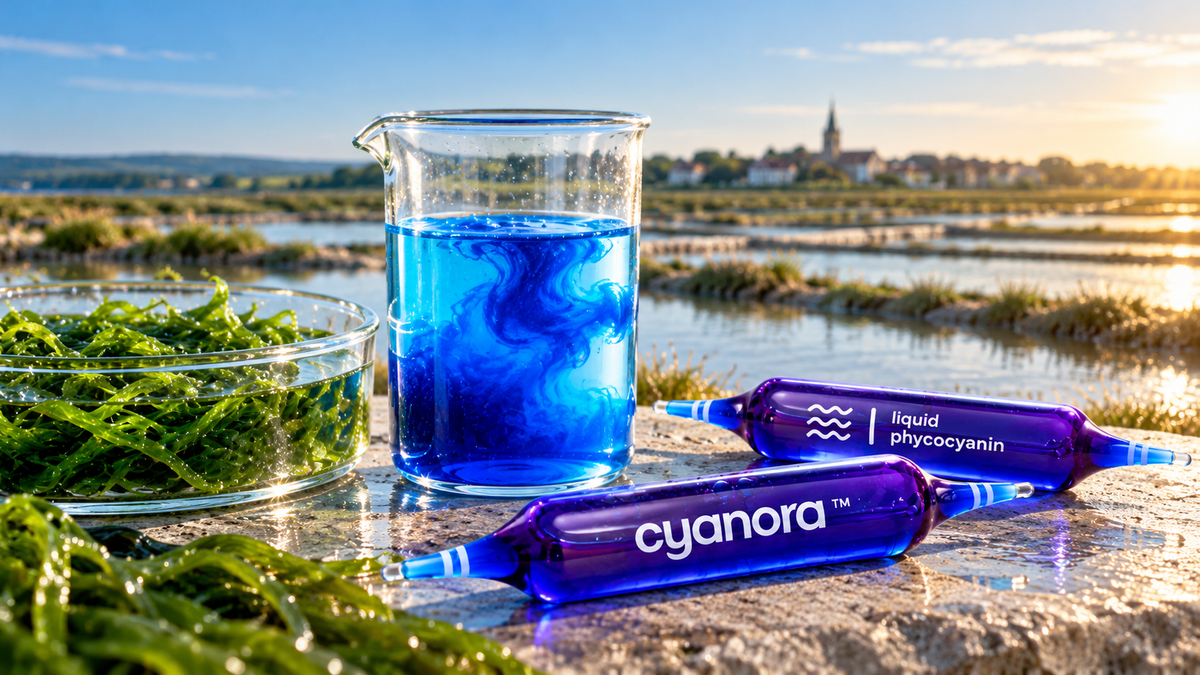
CYANORA's Liquid Phycocyanin Daily Shot is presented in individually sealed 10 mL ampoules.
Each ampoule provides a measured serving, eliminating the need to measure powder or liquid from a larger container.
This format brings together specialized French manufacturing and everyday convenience.
7. What Is Inside a CYANORA Daily Shot?
CYANORA Liquid Phycocyanin Daily Shot provides a clearly stated amount of phycocyanin.
Each 10 mL ampoule contains 20 mg of phycocyanin, corresponding to a concentration of 2,000 mg/L.
Each box contains 15 individual daily shots.
Behind this formulation are several important elements:
-
Spirulina cultivated in Brittany, France.
-
A specialized French biotechnology manufacturing partner.
-
A patented cold-water extraction process developed by that partner.
-
A liquid formulation packaged in individual 10 mL ampoules.
-
Clearly communicated phycocyanin content per serving.
For CYANORA, transparency means helping consumers understand not only what is in the product, but also how it is produced.
8. What Should Consumers Look for?
When choosing a liquid phycocyanin supplement, it is useful to consider several questions.
Where was the spirulina cultivated?
What extraction method was used?
How much phycocyanin does each serving contain?
What ingredients are included in the finished formulation?
How is the product packaged and stored?
These details provide a more meaningful understanding of a product than its blue color alone.
A higher concentration or a particular extraction technique does not, by itself, guarantee better health outcomes.
Understanding the complete formulation and manufacturing process is essential to making an informed choice.
French Science, From Brittany to America
Behind every CYANORA Liquid Phycocyanin Daily Shot is a journey that begins with freshwater spirulina and continues through specialized French biotechnology.
Our manufacturing partner's Patented Cold-Water Extraction Process reflects years of scientific development focused on working with delicate microalgae-derived compounds.
CYANORA brings this French expertise to the United States in a convenient liquid daily supplement.
Because the science behind an ingredient matters.
And understanding how it is made is part of understanding what makes it different.
CYANORA — French Science. Brittany Origins. A New Perspective on Daily Wellness.
This article is for educational purposes only and does not constitute medical advice. CYANORA dietary supplements are not intended to diagnose, treat, cure, or prevent any disease.