Phycocyanin vs. Spirulina: What’s the Difference?
The story of a naturally blue molecule, French biotechnology, and the art of extracting what matters.
Spirulina is widely recognized in the world of natural nutrition. Its deep green color, distinctive composition, and long history of use have made it a familiar ingredient in wellness routines.
But hidden within that green is something unexpected.
Blue.
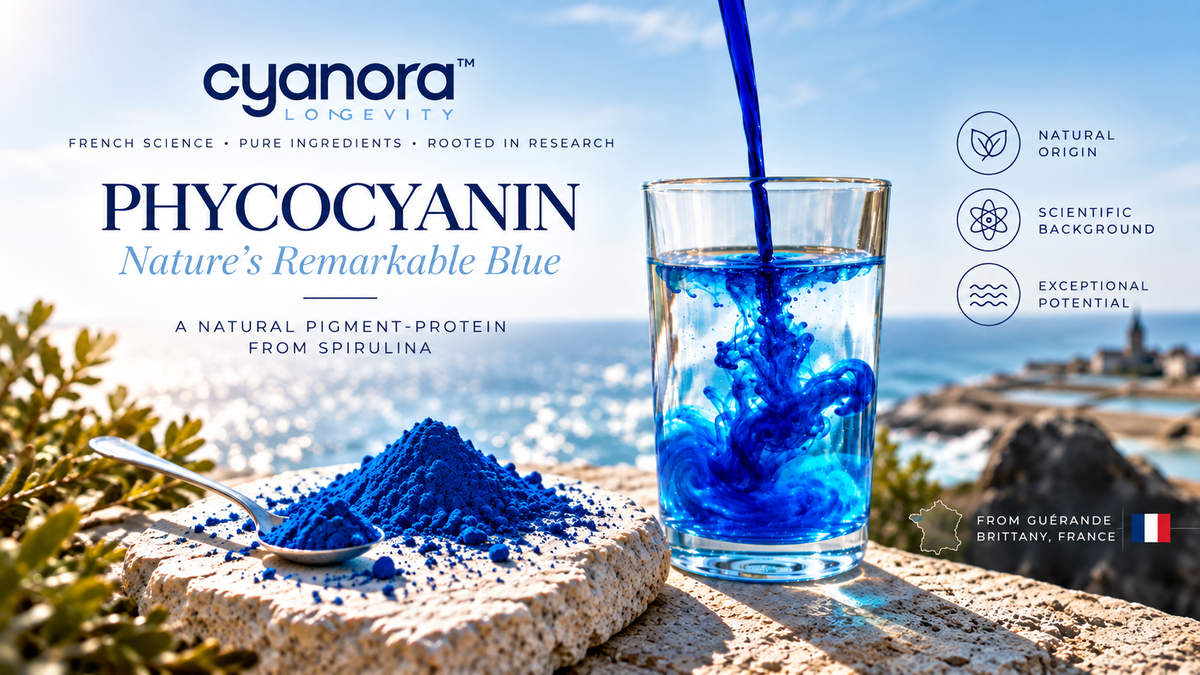
More precisely, phycocyanin — a naturally occurring blue pigment-protein complex found within spirulina.
At Cyanora, this distinction is central to everything we do. We don't simply offer spirulina in another form. We focus on extracting its signature blue component, using French biotechnology and a carefully controlled liquid process.
To understand why, we need to start at the source.
Spirulina and Phycocyanin: The Difference at a Glance
| Spirulina | Phycocyanin | |
|---|---|---|
| What is it? | A photosynthetic cyanobacterium | A natural blue pigment-protein complex |
| Where does it come from? | Cultivated biomass | Extracted from spirulina |
| Composition | Proteins, pigments, minerals and other nutrients | A specific pigment-protein fraction |
| Common formats | Powder, tablets, capsules | Liquid extracts and powders |
| Cyanora's approach | Spirulina cultivated in Guérande, France | Cold-water extraction and liquid Daily Shot |
The simplest way to understand it: spirulina is the source. Phycocyanin is the blue within.
What Exactly Is Spirulina?
Spirulina is the common name for certain photosynthetic cyanobacteria, primarily belonging to the genus Arthrospira.
Although often called a blue-green algae, spirulina is technically a cyanobacterium.
It naturally occurs in warm, alkaline aquatic environments and is cultivated for its nutritional composition, including proteins, pigments, and minerals.
Traditionally, spirulina is harvested and dried before being transformed into powders, tablets, or capsules.
These formats retain a broad mixture of the organism's natural components.
But spirulina contains more than the nutrients most people associate with it.
It also produces a blue pigment-protein complex that helps capture light during photosynthesis.
That complex is phycocyanin.
What Is Phycocyanin?
Phycocyanin belongs to a family of naturally occurring proteins called phycobiliproteins.
These proteins participate in photosynthesis by helping cyanobacteria absorb and transfer light energy.
Phycocyanin is especially recognizable because of its brilliant blue color.
Unlike the green pigments commonly associated with spirulina, phycocyanin produces the vivid blue that has made it an ingredient of growing scientific and commercial interest.
But color is only part of the story.
Phycocyanin has a distinctive molecular structure, and researchers continue to investigate its properties, stability, and potential applications.
For Cyanora, it represents an opportunity to work with one particular component of spirulina rather than the whole organism.
From Green Spirulina to Natural Blue
We begin with spirulina. We focus on its blue essence.
Imagine looking at spirulina not simply as a finished ingredient, but as the starting point for a more selective process.
Whole spirulina contains numerous naturally occurring substances.
Phycocyanin is one of them.
Through extraction, it is possible to recover a liquid fraction rich in this blue pigment-protein complex.
This is an important distinction.
Cyanora is not offering powdered spirulina dissolved in water. Our approach begins with cultivated spirulina and uses a dedicated extraction process to recover its blue component in liquid form.
The result is a liquid spirulina extract rich in phycocyanin.
It is this approach that defines our first Daily Shot.
Why the Extraction Process Matters
Not all extraction methods are the same.
Phycocyanin is sensitive to its environment. Scientific studies have examined how temperature, pH, light, and processing conditions influence its stability.
Excessive heat and unsuitable processing conditions can affect the structure and characteristics of this delicate pigment-protein complex.
Because phycocyanin is water-soluble, it can be recovered using water-based extraction methods.
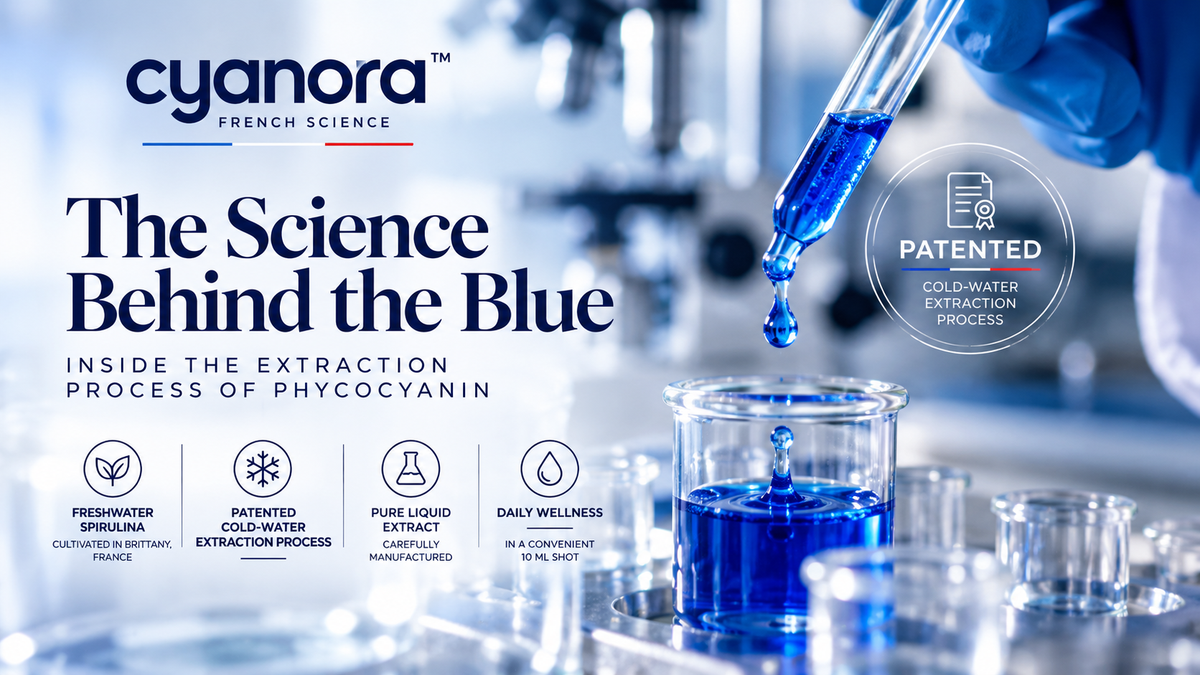
Cyanora's French biotechnology partner uses a proprietary cold-water extraction process designed to recover phycocyanin while preserving its native characteristics.
The objective is not simply to create a blue liquid.
It is to approach extraction with precision, from the selection of the starting material to the handling of the finished ingredient.
Because how an ingredient is prepared matters as much as where it comes from.
Born in Guérande, Brittany, France
<text color="secondary" italic>Where French cultivation meets biotechnology.</text>
On France's Atlantic coast, Guérande is known for its distinctive landscapes, salt marshes, and relationship with the natural environment.
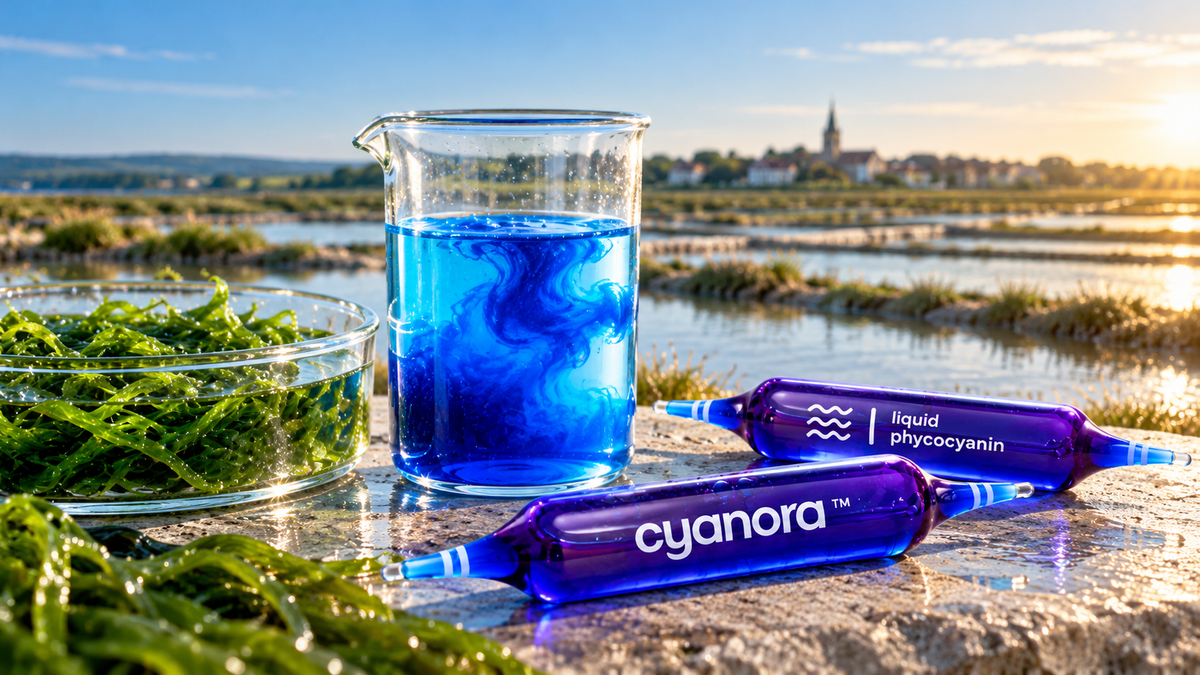
It is also where the spirulina used for Cyanora's phycocyanin is cultivated at our partner's farm.
This connection to Brittany is more than a reference on our packaging.
It gives our ingredient a specific geographic origin and connects it to French cultivation and biotechnology expertise.
From the spirulina cultivated in Guérande to the liquid extraction process, our approach places importance on origin, traceability, and preparation.
We believe consumers should know more about the ingredients they choose.
Not just what they are called.
But where they come from and how they are made.
Why Cyanora Chooses a Liquid Daily Shot
Spirulina is commonly consumed in dried forms.
Phycocyanin, however, can be recovered and prepared as a liquid extract.
For Cyanora, choosing a liquid format is a natural extension of our extraction approach.
Our Daily Shot presents the ingredient in a convenient format that fits into a simple daily routine.
And it allows something extraordinary to remain visible: phycocyanin's naturally blue color.
It is important to distinguish convenience from clinical performance. A liquid format does not, by itself, demonstrate better absorption or greater effectiveness than another format. Those comparisons require specific scientific evidence.
Our choice is grounded in ingredient preparation, presentation, and the experience we want to create.
Is Phycocyanin Better Than Spirulina?
The more useful question is: What are you looking for in an ingredient?
Whole spirulina and phycocyanin extracts have different compositions.
Spirulina offers the broader nutritional profile of the organism.
A phycocyanin-rich extract focuses on one particular component.
Neither should automatically be considered superior.
At Cyanora, we have chosen to specialize in the blue fraction of spirulina because it allows us to combine a clearly defined ingredient focus with a distinctive French extraction process.
That is our approach.
Not a claim that one form is universally better than another.
A Different Perspective on Natural Ingredients
There is a difference between following an ingredient trend and understanding an ingredient from its origin.
Cyanora was created around the belief that thoughtful sourcing, scientific expertise, and careful preparation deserve a central place in modern wellness.
Our story begins with spirulina cultivated in Guérande.
It continues with the extraction of its natural blue component.
And it becomes part of a daily routine through our Liquid Phycocyanin Daily Shot.
From Brittany, France. Powered by Phycocyanin.
Because exceptional ingredients deserve to be understood.
Discover the Cyanora Liquid Phycocyanin Daily Shot.
CYANORA Editorial
BLUE, BY NATURE.
The Science Behind the Blue
For readers interested in the science of phycocyanin extraction and stability:
1. Jaeschke, D. P., Teixeira, I. R., Marczak, L. D. F., & Mercali, G. D. (2021). Phycocyanin from Spirulina: A review of extraction methods and stability. Food Research International, 143, 110314.
https://doi.org/10.1016/j.foodres.2021.110314
2. Physicochemical degradation of phycocyanin and means to improve its stability: A short review. Journal of Pharmaceutical Analysis.
https://doi.org/10.1016/j.jpha.2021.12.005
Scientific references are provided for educational purposes and do not establish clinical efficacy for the finished Cyanora product.