WHAT IS PHYCOCYANIN?
You may already know spirulina, the distinctive blue-green microorganism widely used in nutrition and wellness. But within spirulina lies something less familiar — and remarkably blue: phycocyanin.
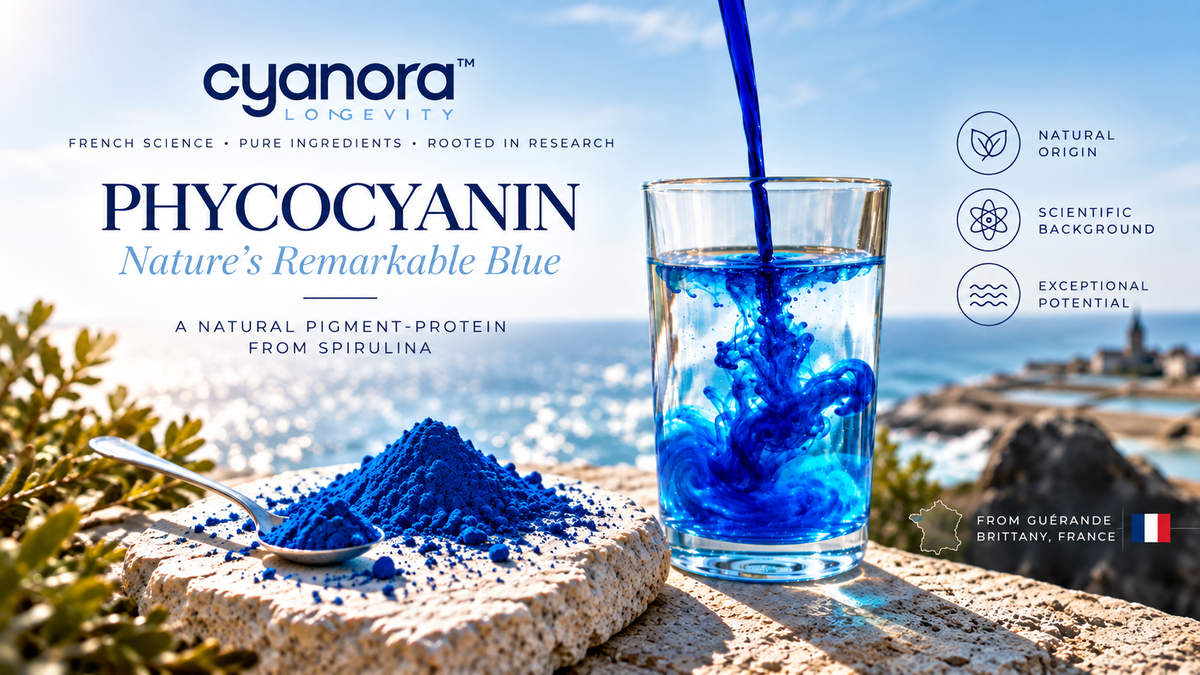
Phycocyanin is a naturally occurring blue pigment-protein found in spirulina. More precisely, it belongs to a family of water-soluble proteins called phycobiliproteins. The predominant form found in spirulina is known as C-phycocyanin, or C-PC.
Its extraordinary color is not simply decorative. In nature, phycocyanin plays an important role in photosynthesis, helping spirulina capture light energy.
Spirulina Is the Source
Phycocyanin and spirulina are closely connected, but they are not the same thing.
Spirulina contains proteins, pigments and other naturally occurring compounds. Phycocyanin is one of its most distinctive components and contributes to spirulina's characteristic blue-green color.
The simplest way to understand the relationship is:
Spirulina is the source. Phycocyanin is the remarkable blue within it.
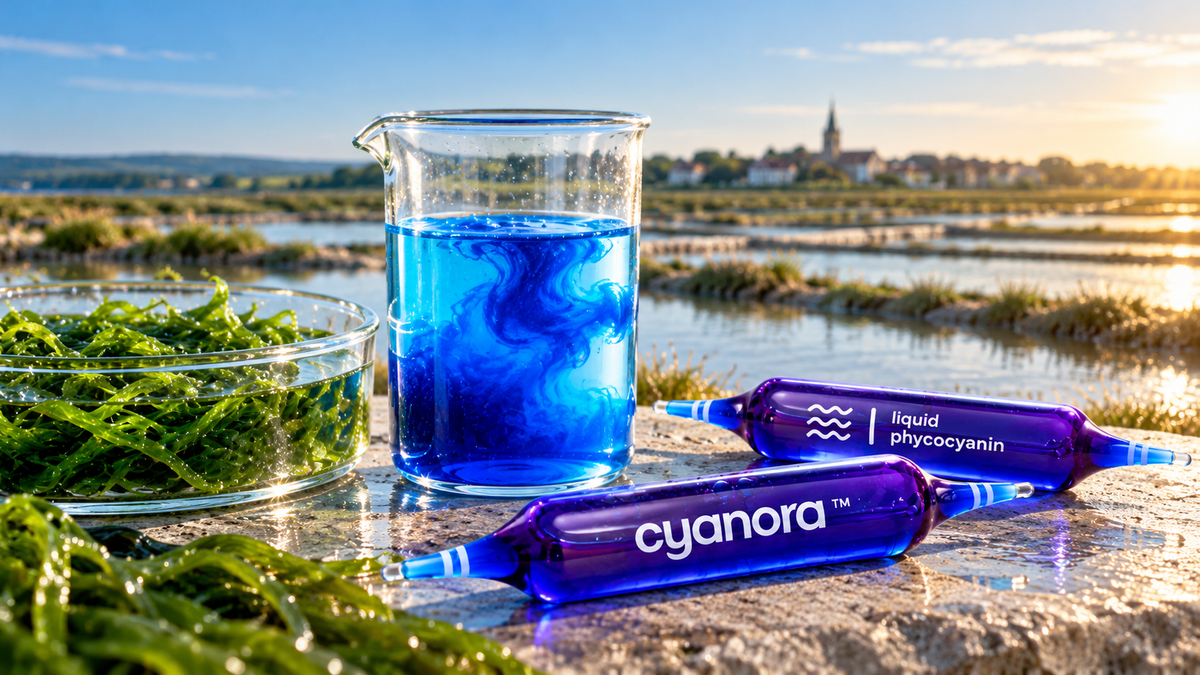
When phycocyanin is extracted and separated from spirulina, its intense natural blue becomes visible in an entirely new way.
Why Is Phycocyanin Blue?
Phycocyanin contains light-absorbing structures called chromophores. These structures are responsible for its brilliant blue color and help capture light during photosynthesis.
This is what makes phycocyanin so visually extraordinary: its vivid blue is created by nature itself.
When dispersed in water, the pigment reveals an intense blue that can range from brilliant azure to deep cobalt depending on concentration and conditions.
Behind that spectacular color is a sophisticated natural system designed to interact with light.
From Spirulina to Phycocyanin
Obtaining phycocyanin requires separating it from the spirulina biomass and carefully processing the resulting extract.
This step matters because phycocyanin is a delicate pigment-protein whose stability can be influenced by factors such as temperature, light and pH.
The journey can therefore be summarized simply:
Spirulina → Extraction → Purification → Phycocyanin
It is where nature meets biotechnology.
A Story Rooted in Brittany
For Cyanora, that journey begins in Guérande, Brittany, France, on the Atlantic coast.
Here, spirulina cultivation and French biotechnology come together to produce the phycocyanin at the heart of Cyanora.
Our approach is simple: respect the ingredient, understand the science behind it, and introduce it to a new generation of consumers through a modern daily ritual.
Phycocyanin is attracting increasing scientific interest, and research continues to explore its composition, properties and potential applications.
There is still much to discover — and that is precisely what makes it fascinating.
At Cyanora, we believe science should be communicated clearly, responsibly and without exaggeration.
This article is only the beginning.
In the Cyanora Journal, we will continue exploring the world of spirulina, phycocyanin and the science behind one of nature's most remarkable blues.
French Science. Pure Ingredients. Rooted in Research.